"Yayoi Kusama Rocks My World!!" This is how Robin Leeanne Dudgeon from Winnipeg named the group she created in Facebook. It currently has 136 members from all over the world and that´s how I found out there´s a film about this amazing japanese artist just about to come out: http://www.kusamadocumentary.com/
I can´t wait to have more news about YK!
May 13, 2008


May 7, 2008
Kandinsky: El número de colores y formas es infinito...
Empecé un curso de historia del Arte de Estados Unidos en el Siglo XX, como un intento de traerme un pedacito de mi vieja Nueva York...
Primeras clases: arte abstracto. Kandinsky. Cuál es el lugar que alberga la mayor colección de Kandinsky? El Guggenheim Museum. De dónde? De NY por supuesto.
Es mentira, obvio, pero por unos instantes, en ese aula, siento algo de esa esencia neoyorkina que no me resigno a perder...

Primeras clases: arte abstracto. Kandinsky. Cuál es el lugar que alberga la mayor colección de Kandinsky? El Guggenheim Museum. De dónde? De NY por supuesto.
Es mentira, obvio, pero por unos instantes, en ese aula, siento algo de esa esencia neoyorkina que no me resigno a perder...
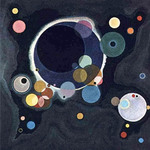
“El número de colores y formas es infinito, y así también son infinitas las combinaciones y al mismo tiempo los efectos. El material es inagotable.”
Wassily Kandinsky
Jan 16, 2008
Me parece que lo único finito es mi felicidad
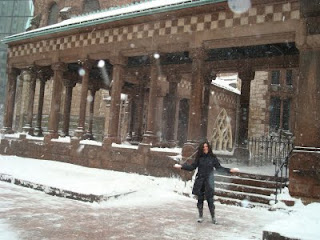
Se me terminó mi año mágico, mis trece meses de ensueño... Se terminaron las postales desde USA! Cuántas postales habré mandado... cuántas me habré quedado con las ganas de escribir...
Aquí les envío una de las últimas fotos de mi último día en Boston, en medio de una tormenta de nieve interminable que provocó cierre de rutas, autopistas, aeropuertos y me hizo temer no llegar a tiempo a NY para tomarme el avión.


Finalmente, abrieron algunas rutas, y como estaban vacías llegué con tiempo de sobra para acomodar el equipaje y pagar algo menos de exceso, jaja!
Ay, como voy a extrañar la nieve , y los Starbucks y el sushi de la esquina, y ese esmalte de uñas barato que tanto me gusta, los blueberry muffins y los ice-coffes.... mejor ni seguir con la lista de pequeñeces irreemplazables...
Hoy es mi primer mañana en Buenos Aires. Y tuve mi primer despertar. Bastante ingrato.
Me desperté con la horrible sensación de ahogo que sólo incontables capas de frazadas y una calefacción arrebatada pueden lograr. Me desperté pensando que tenía que apagar la calefacción.
Y por un segundo, antes de abrir los ojos, sentí que estaba allá.
Pero poco tardé en darme cuenta de que en realidad la tormenta de la noche había bajado la temperatura de este pegajoso verano porteño.
Viajar de un hemisferio a otro me llevó más de medio día... Pero entender porqué estoy acá de nuevo... no sé cuánto tiempo me llevará... Hasta mi cuerpo no entiende porqué tiene que lidiar con esta infinita diferencia térmica...
Y ahora, mientras escribo esto y miro fotos neoyorkinas, a veces pienso "No quiero volveeer, me quiero quedaaar, esta es mi vida ahora", pero cada vez tardo menos en darme cuenta de que mi felicidad está conociendo sus límites...en realidad ya volví a Buenos Aires, y no sé cuando voy a volver a mi ciudad, esa gran manzana que elegí y me eligió :(
Nov 18, 2007
Schiller: Toda poesía debe tener como contenido lo infinito
Schiller afirma que toda poesía debe tener como contenido lo infinito; pero que esto se puede conseguir de dos maneras: un infinito por la forma (poeta ingenuo) o un infinito por la materia (poeta sentimental). Al ingenuo la naturaleza le permite conseguir su objetivo porque es infinita en su forma, sin embargo para el sentimental constituye una limitación, ya que debe otorgar al objeto un contenido absoluto.
http://www.ucm.es/info/especulo/numero25/schiller.html
http://www.ucm.es/info/especulo/numero25/schiller.html
Nov 11, 2007


Oct 23, 2007
Schopenhauer: serie de tiempo infinita
Cada uno debe, pues, concebirse a sí mismo como un ser necesario, es decir, como un ser cuya auténtica definición, cuya definición adecuada, por poco que pueda llegar a formularse ésta, debería acarrear ya la existencia. En este orden de pensamientos se encuentra realmente la única prueba inmanente, es decir, contenida en el ámbito de los datos de la experiencia, que pueda alegarse sobre la inmutabilidad de nuestro verdadero ser. La existencia, efectivamente, debe ser inherente a él, puesto que se muestra independiente de todos los posibles estados, traídos consigo por la cadena de las causas, porque esos estados ya han encontrado su realización y nuestra existencia ha permanecido con todo y con ello incólume a su choque, como un rayo de luz ante la tormenta que atraviesa. Si por sus propias fuerzas pudiera conducirnos el tiempo a un estado de bienaventuranza, ya lo habríamos alcanzado hace largo tiempo, porque detrás de nosotros se extiende un número infinito de siglos. Pero de igual modo si pudiera llevarnos a la destrucción, haría tiempo que no estaríamos aquí. Lo que ahora somos resulta, bien mirado, que debemos seguir siéndolo en todo tiempo, porque somos el propio ser que ha recogido el tiempo para colmar su propio vacío; por dicha causa ese ser llena la totalidad del tiempo, presente, pasado y futuro de igual modo, y por eso también nos es imposible caer fuera de la existencia y fuera del espacio. Mirando bien las cosas, es inconcebible que lo que una vez existe en toda la fuerza de la realidad deba un día quedar reducido a nada, y luego deje de ser durante un tiempo infinito. De aquí resulta para los cristianos la doctrina de la resurrección universal; para los hindúes, la de la creación del mundo por Brahma, renovada una y otra vez, sin contar todos los dogmas semejantes de los filósofos griegos. El gran misterio de nuestro ser y nuestro no-ser, cuya explicación ha suscitado estos dogmas y todos los otros parecidos, tiene como fundamento último el que la misma cosa que objetivamente constituye una serie de tiempo infinita, no es subjetivamente más que un punto, un presente indivisible y siempre existente; pero ¿quién puede entenderlo?
El mundo como voluntad y representación
p.237-241 de la selección de Michel Piclin,
Schopenhauer, EDAF, Madrid 1975
p.237-241 de la selección de Michel Piclin,
Schopenhauer, EDAF, Madrid 1975
Disponible en: http://www.nietzscheana.com.ar/textos_de_schopenhauer.htm
Jul 19, 2007
Yayoi Kusama is everywhere (USA 2007)
***Peter Blum SOHO Gallery, New York, NY  I have been making prints ever since I was captivated by their allure, and am constantly overwhelmed by the brilliance arising from within the process of making them. - Yayoi Kusama
Peter Blum Gallery is pleased to announce the exhibition Yayoi Kusama Prints from 1982 to 2004, at Peter Blum SoHo, 99 Wooster Street, New York. This is the first survey of Kusama's prints in the United States. On view will be a selection of over 20 years of her print works, including etchings, lithographs, and silkscreens. Kusama's prints reflect ideas and themes found throughout her entire body of work. Her prints, like her work in other mediums, reveal her unique vision of the world. Kusama has said that from a young age she suffered from hallucinations, seeing auras and dots and hearing voices from plants and animals. Rather than battle with these visual and audible illusions, she painted and drew them. As a result, her characteristic imagery of infinity nets, monochrome colors, repetitive and abstract forms developed, and was often incorporated in her prints, installation, sculpture, painting, collage and performance. Furthermore, the repetitive process of printmaking and the idea of multiples appeal to her aesthetic. Yayoi Kusama was born in 1929 in Matsumoto-shi, Nagano-ken, Japan. She currently lives and works in Tokyo, Japan. She has exhibited extensively internationally, including a significant solo exhibition in 1989 at the Center for International Contemporary Arts, New York, and a major retrospective that traveled to the Los Angeles County Museum of Art, the Museum of Modern Art, the Walker Art Center and the Museum of Contemporary Art, Tokyo, in 1998-1999. In addition, Kusama was the representative artist for Japan in the 1993 Venice Biennial.
EXHIBITION AT PETER BLUM SOHOMay 24 - July 27, 2007EXTENDED (Following Summer Break) Open August 21-25YAYOI KUSAMA: Prints from 1982 to 2004 http://www.peterblumgallery.com/soho.html
***Museum of Fine Arts, Boston, MA: Contemporary Outlook: Japan ( July 2, 20 07 - February 10, 2008 ) Printable
I have been making prints ever since I was captivated by their allure, and am constantly overwhelmed by the brilliance arising from within the process of making them. - Yayoi KusamaPeter Blum Gallery is pleased to announce the exhibition Yayoi Kusama Prints from 1982 to 2004, at Peter Blum SoHo, 99 Wooster Street, New York. This is the first survey of Kusama's prints in the United States. On view will be a selection of over 20 years of her print works, including etchings, lithographs, and silkscreens. Kusama's prints reflect ideas and themes found throughout her entire body of work. Her prints, like her work in other mediums, reveal her unique vision of the world. Kusama has said that from a young age she suffered from hallucinations, seeing auras and dots and hearing voices from plants and animals. Rather than battle with these visual and audible illusions, she painted and drew them. As a result, her characteristic imagery of infinity nets, monochrome colors, repetitive and abstract forms developed, and was often incorporated in her prints, installation, sculpture, painting, collage and performance. Furthermore, the repetitive process of printmaking and the idea of multiples appeal to her aesthetic. Yayoi Kusama was born in 1929 in Matsumoto-shi, Nagano-ken, Japan. She currently lives and works in Tokyo, Japan. She has exhibited extensively internationally, including a significant solo exhibition in 1989 at the Center for International Contemporary Arts, New York, and a major retrospective that traveled to the Los Angeles County Museum of Art, the Museum of Modern Art, the Walker Art Center and the Museum of Contemporary Art, Tokyo, in 1998-1999. In addition, Kusama was the representative artist for Japan in the 1993 Venice Biennial.
EXHIBITION AT PETER BLUM SOHOMay 24 - July 27, 2007EXTENDED (Following Summer Break) Open August 21-25YAYOI KUSAMA: Prints from 1982 to 2004 http://www.peterblumgallery.com/soho.html
***Museum of Fine Arts, Boston, MA: Contemporary Outlook: Japan ( July 2, 20 07 - February 10, 2008 ) Printable
In her series “The Artist Papers,” Kunie Sugiura makes life-sized photograms depicting characteristic gestures, performances, and actions by a variety of famous artists, including Takashi Murakami.
Since Japan dropped its longstanding policy of national isolation in the 1850s, there has been an immensely creative give-and-take between the cultures of Japan and the West. After World War II, especially, many Japanese artists began working in art forms derived from the international scene, moving away from local traditions. At the same time, traditional subject matter and styles endured. While some artists explored new and different motifs and styles using traditional media, others embraced Western materials, subject matters, and styles. This installation is by no means a complete review of recent art from Japan; instead it focuses on a few selected works created by artists of three recent generations. The first came of age directly after World War II; some are just coming to the world’s attention now. Strains of western styles and approaches like abstract expressionism, pop, “happenings,” minimalism, and feminist art can be seen here, but the results are also uniquely Japanese in concerns and approach. The works are the product of a particularly fertile period of artistic experimentation, one that generated a unique synthesis of ideas and forms from East and West. Artists in the exhibition include Yayoi Kusama, Takashi Murakami, Daido Moriyama, Mariko Mori, and Chinatsu Ban.Contemporary Outlook is an exciting new series of small focused exhibitions, drawn mainly from the MFA collections, that examines emerging trends, issues, ideas, and ways of looking at art and artists.
***Whitney Museum of American Art, New York, NY: Summer of Love: Art of the Psychedelic Era on view May 24, 2007 - September 16, 2007
Summer 2007 revisits the unprecedented explosion of contemporary art and popular culture brought about by the civil unrest and pervasive social change of the 1960s and early '70s, when a new psychedelic aesthetic emerged in art, music, film, architecture, graphic design, and fashion. The exhibition includes paintings, photographs and sculptures by Isaac Abrams, Richard Avedon, Lynda Benglis, Richard Hamilton, Elliott Landy, Jimi Hendrix (his only known watercolor), Robert Indiana, Yayoi Kusama, Richard Lindner, and John McCracken, among others, as well as a rich selection of important posters, album covers and underground magazines. A special emphasis is placed on environments as well as on film, video and multimedia installations, including works by Jordan Belson, USCO, Stan VanDerBeek, James Whitney, and Lamonte Young and Marian Zazeela. The exhibition includes films of performances and light shows, and spotlights places such as the UFO nightclub in London and the Human Be-In in San Francisco, featuring Allen Ginsberg and Timothy Leary. Organized by Tate Liverpool and originally presented there, the show has toured to the Kunsthalle Schirn Frankfurt and the Kunsthalle Wien.
Subscribe to:
Posts (Atom)


 Posts
Posts


